 Episode 2
· 21:42
Welcome to the Psychedelic News Feed, a podcast from Psychedelic Alpha. Each episode brings you up to speed with the latest across psychedelic drug development, policy and access from around the world. It's presented by me, Josh Hardman, Psychedelic Alpha's founder and editor. These are intended to be concise summaries as opposed to deep dives. If you are looking for more nuanced analysis, exclusive interviews and unrivaled reporting on these topics and much more, head to psychedelicalpha.com.
Speaker 1:Welcome to our second episode of the Psychedelic News Feed podcast. Thanks to all of you who listened to the first episode and especially to those who left a review and or shared it with a colleague or a friend. We really appreciate your support. We've got another very busy news feed this week, which will consist of me talking you through developments from the past couple of weeks in the psychedelics field across drug development, policy, and access. We also have a couple of interviews today with people who are close to two of the stories that we're sharing.
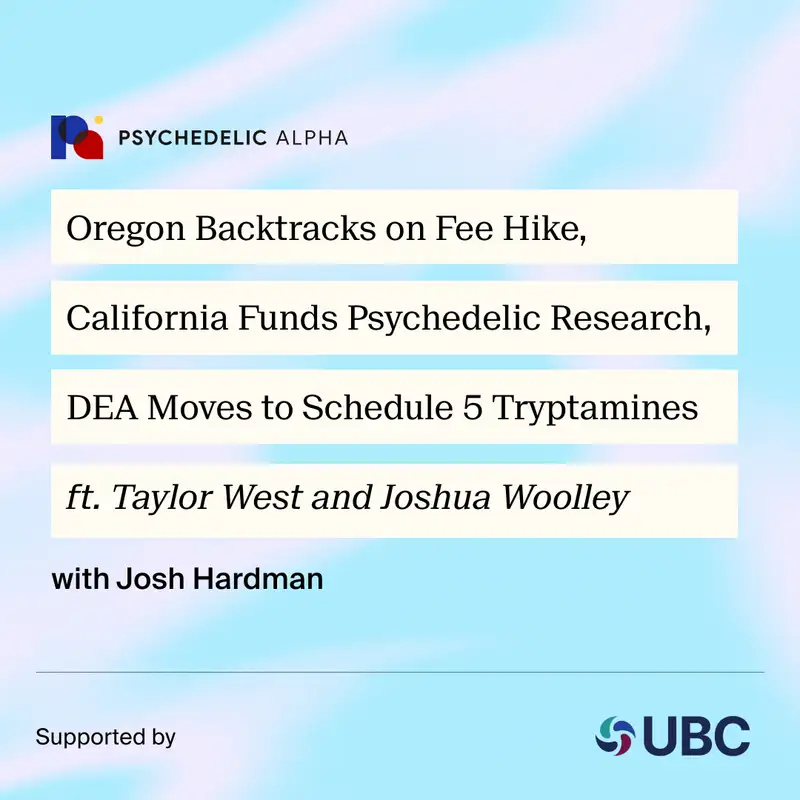
Speaker 1:So those stories will include these headlines as well as some other stories. So the first is that Oregon has scrapped plans to double psilocybin licensing fees in its state regulated program. California has carved out some funding for psychedelic research. The Drug Enforcement Administration, the DEA, has reinvigorated a plan to place five tryptamines in Schedule one of the Controlled Substances Act. There's a white paper out that summarizes some findings from an RFI issued by the past caucus last year.
Speaker 1:And lastly, at least for those headline stories, researchers in California are making the case for more aggressive masking or blinding in psychedelic studies, and I speak to one of the authors there. This episode of the Psychedelic News Feed is supported by UBC. As psychedelic therapies move toward potential approvals, UBC helps sponsors navigate the evidence generation, pharmacovigilance, and comprehensive risk management strategies that support a path forward grounded in patient safety. Learn more at ubc.com. The Oregon Health Authority has said that it will not be moving forward with plans to significantly increase licensing fees, which would have effectively seen them double the fees levied on various psilocybin services participants and entities in order to meet what they described as a budget shortfall. Oregon Psilocybin Services then merged with the state's marijuana division again in a related cost saving push. Now advocates and operators in that system have hailed the move as a victory. They had expressed concerns that the drastic fee hikes would have made an already difficult operating environment even more challenging. Indeed, session numbers in the Oregon model had been trending down over the past few quarters, but they had picked up slightly in Q2 according to data released by Oregon Health Authority. I spoke with Taylor West, executive director of Healing Advocacy, a nonprofit that has thus far worked primarily on shoring up access to psychedelics in state regulated models about the news.
Speaker 1:So, Taylor, thanks for joining me. So Oregon Health Authority has scrapped this planned fee hike. You see this as a win. Right?
Speaker 2:Absolutely. You know, this was an attempt to fix a question around the budget that really had not been addressed in a broader way. This was a decision that was made without enough transparency on how the funding was being used in the regulatory program, and at a time when we actually have the ability to take a step back, look at how the program is working, and make considered decisions about how best to create sustainability for the long term. We've been making that case to the Oregon Health Authority and to the Oregon governor's office and several others for the last few months. The community really spoke up about it, and we're grateful that we were heard and that there's a decision to reassess.
Speaker 1:Okay. And if you were going to convince the regulators or the local government of the viability or why they should be sort of underwriting this program, what would that look like? Would it be things like outcomes data, health economics? And if so, how are you collecting that?
Speaker 2:Yeah, absolutely. So what's beautiful about this moment is that we are now starting to get the first really rigorous outcomes data coming from the program. I mean, just a few weeks ago, we hosted a conference in Oregon with a group of different researchers who were all doing outcomes research on the state regulated program in Oregon. And we're seeing remarkable results. You know, we're seeing results that mimic or that mirror the clinical trial results where we're getting significant decreases in PTSD symptoms, in depression symptoms, in anxiety symptoms.
Speaker 2:We have research showing significant beneficial effect on alcohol use disorder. And these are all things that are going to be, will have been affecting the state's bottom line when it comes to their approach to mental health and behavioral health. So having a tool that is now starting to show some very real benefit at a time when the whole state is trying to decide how to create a long term sustainable approach to mental health is exactly the argument that we need to be making, that this is now not just a siloed program that is sort of an experiment in a new tool, but rather something that is showing the kind of results that deserves to be integrated into the state's full approach to behavioral health.
Speaker 1:And so you're advocating for bringing this into OHA's more regular mental behavioral health policy or programming. And that's obviously happening at a time when we could be seeing approval more conventionally FDA approved versions of psilocybin. So I wonder how do you see those two models as coexisting or perhaps rubbing up against each other, or are there unique benefits of one versus the other?
Speaker 2:Yeah, absolutely. Our belief is that these are entirely complementary pathways. The prescription opportunity is very exciting and is a real benefit to both the field and to people who are going to qualify for that prescription access. But it will be for people with very specific diagnoses, for people who have access to the kind of direct medical approach that it will take to receive that treatment, and to insurance that will be willing to cover what is almost certainly going to be a fairly expensive treatment plan. At the same time, the non prescription pathway, the program that we've built in Oregon and that we're starting to see in other places like Colorado, offers the opportunity to access care for people who either don't meet one of the diagnoses or aren't in a position to go through the medical process to access this.
Speaker 2:And one of the fascinating things about psychedelics and about psilocybin in this case is just how wide a span of things it can be beneficial for. And not all of those are just sort of narrow diagnoses. One thing I like to think about a lot is, you know, there are people who maybe have not reached a clinical diagnosis for major depressive disorder or treatment resistant depression or, you know, the other PTSD or, you know, things like this, the other indications that are being considered. And the non prescription pathway allows people to actually prevent themselves from getting to that diagnosable point. So I really see these as two pathways that can operate together.
Speaker 2:And between the two of them, we are able to cover the full swath of people who can really benefit from this access.
Speaker 1:Also at the state level in The US, California's twenty twenty six to twenty seven budget bill, a b one one three, includes a 4,700,000 appropriation for psychedelic research. That research is to be carried out via the California Initiative to Advance Precision Medicine and has a focus on veterans. It comes after years of failures among psychedelic advocates to introduce and have passed psychedelic specific bills in the state, including one where the governor Gavin Newsom vetoed a bill that passed that would have decriminalized personal possession and use of certain natural psychedelics, and that was back in 2023. So this time, a standalone psychedelic specific funding bill was rolled into the larger state budget bill. And as we say, it focused only on research.
Speaker 1:So presumably, it was more palatable to lawmakers and ultimately to governor Newsom. While many US federal agencies appeared to be sort of lining up to explain how they're supporting psychedelic research and potential access, especially following that executive order in April, the Drug Enforcement Administration, or DEA, has been somewhat lethargic, to say the least. Now the agency has published a notice of proposed rulemaking that seeks to place five tryptamine psychedelics in schedule one of the Controlled Substances Act, the CSA. It first sought to do so back in 2022, but then withdrew the proposed rulemaking that summer and requested an updated evaluation from the Department of Health and Human Services. Well, that updated evaluation has come from HHS, and it has maintained its earlier schedule one recommendation.
Speaker 1:So now DEA is moving to place them in that schedule, but the public can comment on the proposed rule making through October 23, and interested persons may request a public hearing. Responses to a request for information issued last year by the PATH Caucus, that's a psychedelics-focused Caucus in The US, where last week summarized in a white paper penned by Pinney Associates that was funded by the advocacy group Apollo PACT. Now responses were quite varied and sort of belies summarizing here, but there were some areas of discord notably among who should deliver psychedelic care. Some called for the involvement only of licensed clinicians, while others hoped to see room for trained facilitators, peer supporters, and indigenous practitioners, for example. The report goes on to suggest various policy initiatives, including expanding congressional support for Department of Defense and VA research, strengthening funding from the National Institutes of Health, using expanded access programs, otherwise known as compassionate use, to broaden access among patients prior to approval, and lastly, encouraging prioritization of psychedelic research and access within the Department for Health and Human Services and the FDA.
Speaker 1:While since that summer twenty twenty five request for information, it's hard to say that prioritization hasn't occurred, As we've reported many times, including in our first episode of this podcast, there does seem to be a lot of impetus among federal agencies in The US to at least appear like they're working hard on this topic. Researchers at Stanford and the University of California, San Francisco have declared that masking in high dose psychedelic clinical trials has failed, meaning almost all study participants have correctly guessed what they've received or which arm they're in in these clinical trials, which is a very well known issue described otherwise as functional blinding or a lack of blinding. But rather than acknowledging the futility here and just giving up as they characterize some other authors' prescriptions, this group of researchers say that the field has not tried sufficiently aggressive approaches. So to discuss some of those approaches and the questions around blinding in general, I spoke with Josh Woolley, one of the researchers behind that paper. So we all know the problem of blinding in psychedelic trials is pretty endemic.
Speaker 1:You and your co authors have talked to a sort of masking nihilism where people in the field have almost kind of given up on the idea of blinding these studies. We've tried things like what? Like niacin, diphenhydramine, and sort of different study designs, and no one seems to have cracked it. So what are you and your co authors proposing in this new article?
Speaker 3:Well, I think the first point is really important that we haven't tried that hard. Everyone talks about it as a major problem. And then what we actually do in the trials are diphenhydramine, niacin, which really don't have any chance of masking the intensity of the experience and yet we keep doing it, or we do less. And a lot of people have said, well, we've never succeeded, so we should give up. But that's not logical,
Speaker 1:right?
Speaker 3:So what we propose is a multi drug approach. So not to be constrained by finding a single drug, but to take our whole armamentarium, if you will, and try and figure out combinations of drugs that could give you a more breadth of experience. It's kind of like more levers that you can manipulate to try and get different aspects, time course, physiological response, sort of the visuals. We don't have the exact combination yet. But the idea that you could try that I think is something that the field hasn't really been talking about.
Speaker 3:And then we propose also combining this multi drug approach with another approach that we have written about before which is incomplete disclosure. The idea there is in a regular double blind trial, we there is some incomplete disclosure. We tell people, we can't tell you exactly what you're going to get, we can tell you the probability. And we say that in psychedelic trials, given how hard masking is, that maybe it's justified to go a little further and not tell people how many arms there are, for example, but tell them that we're not going to tell them. So people are consenting to the study, knowing that there are some things that we can't tell them.
Speaker 3:We always propose telling safety related things. And so we think that those two things together, the multidrug placebo, this incomplete disclosure is a process that at least conceivably could achieve, better masking. And that's what we call Umbra.
Speaker 1:And and what would success look like that? I mean, you're presumably not expecting to achieve full kind of random guessing, like, 50%
Speaker 3:the dream. You know? Yeah. And if you could actually
Speaker 1:achieve But even if you just got closer to, you know, farther away from what the 95% of the moment, you could still presumably with a large enough sample make inferences about.
Speaker 3:Yeah, that's right. So we, you know, we make this case that it's not an all or nothing thing, you know, like SSRIs are not perfectly masked either with when this when they look, it's about sixty two percent people guess correctly. With psychedelics, the meta analysis suggests it's over 90 and it's like immediate and like, you know, it's a problem. If we could get that down to 80 or 70, every step increases our ability to make causal inference. If you had more variability in what people thought they got, some people getting it wrong, you begin to have some ability to see how much what you think you got mattered.
Speaker 3:That that really
Speaker 1:For sure. Some people read all the critiques of psychedelic blinding in studies in general. And their argument is that this is all a bit academic. When these treatments are given to patients, it doesn't matter whether they're blinded or not. They're all gonna be unblinded.
Speaker 1:And if the patient gets better, then why does it matter? I mean, how do you respond to that?
Speaker 3:Yeah, well, that's a great point. And this is not just about umbra, right? This is about placebos in general, right? Like randomized double blind trials or even control trials really are unnatural. And they're not what clinical practice does, right?
Speaker 3:In clinical practice, we tell people you're getting this and we give it to them and we're like, how's it going? You know, we all that expectancy is all in there. That's totally true. However, we've decided as a society, that that is not adequate, evidence for efficacy. And there are good reasons for that, right?
Speaker 3:There are lots of examples where open label trials totally seemed like it worked. We're like, my god, it totally works. We should totally do this. And then when we do mass trials, we're like, Oh, actually, no. And I can give you a whole slew of them.
Speaker 3:One is, steroid injections into the knee. You know, I have knee arthritis. And, you know, for a while there people were like, Oh, it totally makes sense. You got inflammation in your knee, we're gonna give you this thing that decreases inflammation. People were like, Oh my god, it totally works.
Speaker 3:Feel so much better. But then they did a blinded trial and it turned out actually it was worse. People had no change in pain. And actually, there was more articular damage. And there are a couple of examples like that.
Speaker 3:So these are important things, right? And the real risk is that if we do roll out something without doing this work, yes, people will get better, but will they consistently get better once the excitement wears off? And would they have gotten better anyway? It's not like these treatments are inexpensive or not burdensome. And so there are major costs, even if it was just a placebo, and had no risk, which isn't true here.
Speaker 3:That would be a significant harm to patients.
Speaker 1:And lastly, can you tell us about the name? Umbra, it's something to do with the shadow, right?
Speaker 3:Yeah, that's right. So, you know, I did kinda torture the English language to make it work, but an umbra is the it is the area of full shadow from an eclipse. So the... It doesn't have to be an eclipse. It's any object.
Speaker 3:But you know, when you have light behind it, you get up the penumbra, which is the partial shadow, and then there's a place of of total shadow. And, you know, obviously, that's the dream that we could achieve complete masking. So that's the goal of it even though that's gonna be hard. But we don't know how how close we can get until we try.
Speaker 1:Aside from those headlines, there are some other stories that we've covered in the past couple of weeks. The first couple come from The US, and then we take a look slightly further afield. So the first is that last week, Portland in Oregon, its city council voted unanimously to insert a new segment into the city code that says that personal noncommercial use of natural psychedelics will be deemed a low enforcement priority for city police. This has been hailed as a win for some local advocates, though it is probably worth noting that this was already very low on the list of enforcement priorities, at least according to assistant chief Franz Schoening of Portland's police department said that he doesn't believe the ordinance will lead to operational changes and that the police bureau were neutral on the legislation. Said he wasn't aware of any cases where they've prosecuted people for personal use that's noncommercial in nature.
Speaker 1:So a win according to advocates, though, it might not change so much. Saying in The US, various chief executive officers of psychedelic drug developers appeared at the MAHA Make America Healthy Again Summit last week. Those were the CEOs of Compass Pathways, Definium Therapeutics, and Helus Pharma, who appeared alongside HHS deputy general counsel Matt Zorn for a moderated panel discussion. The company's paid for that stage time according to Politico. There's plenty going on beyond The US too.
Speaker 1:In the last couple of weeks, a Finnish neuroplastogen, so one of these non hallucinogenic psychedelic, drug developers called Kasvu Therapeutics raised a €30,000,000 financing, and they're exploring the track B mechanism that potentially modulates neuroplasticity to create potentially medicines that generate this neuroplasticity without the psychedelic effects. Interestingly, when I contacted the scientist whose work this company was founded on a couple of years ago, he asked, he sort of said, why are you looking to cover me? You know, we're not working on psychedelics. It's probably not appropriate for psychedelic alpha, but in the press release announcing this, this fundraise, they mentioned psychedelics around 10 times, I believe. So perhaps shows just how much has changed now in terms of investor appetite for psychedelics and related compounds.
Speaker 1:And lastly, researchers at Copenhagen University Hospital in Denmark have outlined plans for a state funded study of psilocybin and apomorphine in unresponsive coma patients. So they're setting out to trial whether psilocybin in conjunction with apomorphine can improve awakening of these patients within thirty days. Some psychedelic researchers have wanted to do these types of studies for some time but have been hamstrung by the tricky ethics around it. Well, this group has received ethics approval from both of the relevant national authorities in Denmark and secured funding from Offerfonden, which is the Danish state fund for victims of crime and traffic accidents. Well, that's it for our second Psychedelic News Feed podcast episode.
Speaker 1:Thanks again for listening. And our next episode will come right after we host the Psychedelic Healthcare Forum in New York City at the New York Academy of Medicine on Thursday, October 15. So I do hope to see many of you there. There are a few last minute tickets, but otherwise, we will be sharing some of the takeaways after that event. So I hope you have a great day, and thanks for listening.
Speaker 1:That's it for this edition of the Psychedelic News Feed. For deeper analysis, exclusive interviews, and reporting that you won't find anywhere else, head to psychedelicalpha.com. Have a great day.
Listen to The Psychedelic News Feed using one of many popular podcasting apps or directories.